
AI Research
Made Accessible
We translate cutting-edge papers from Google DeepMind, OpenAI, Anthropic, and top research labs into plain English. No PhD required.
Research from leading AI labs
The Problem
1,000+ AI papers are published every month. Most are written for researchers with advanced ML degrees. The key insights that could transform your AI strategy are locked behind dense jargon, complex mathematics, and 40-page PDFs.
How We Translate Research
Every paper goes through our rigorous translation process
Plain English Rewrites
We translate complex concepts into language anyone can understand. No jargon, no assumed knowledge, no dense equations.
Interactive Visualizations
D3.js charts, architecture diagrams, and animated explanations that make abstract ideas concrete and memorable.
Accessibility Techniques
Info boxes explain technical terms inline. Analogies connect new concepts to things you already understand. No one gets left behind.
TL;DR Summaries
Every article opens with a 3-point summary. Get the problem, solution, and results in 30 seconds flat.
Key Findings
5-6 bullet points highlight the most important takeaways in plain language. Scannable, shareable, and jargon-free.
Practical Focus
We emphasize what you can actually build with this research. Implementation details, not just theory.
Implementation Blueprint
Research papers tell you what works. They rarely tell you how to build it.
Every Tekta.ai article includes an Implementation Blueprint - our unique addition that bridges the gap between academic research and production code. This is what sets us apart from paper summaries elsewhere.
- Tech stack recommendations Specific tools, not vague suggestions
- Code snippets Working examples you can adapt
- Key parameters The numbers that actually matter
- Pitfalls & gotchas What will trip you up
# Recommended tech stack
stack = {
    "base_model": "Phi-3 (7B)",
    "fine_tuning": "LoRA via PEFT",
    "serving": "vLLM",
}

# Key parameters
config = {
    "batch_size": 1024,
    "learning_rate": 1e-4,
    "layers_to_update": "final 1/4",
}

# What will trip you up
gotchas = [
    "Don't update all layers",
    "Monitor for overfitting",
    "Check licensing terms",
]
Before & After
See how we transform dense research into clear insights
"We propose a novel architecture leveraging hierarchical attention mechanisms with learned positional encodings to facilitate long-range dependency modeling in autoregressive sequence transduction tasks. Our ablation studies demonstrate that the integration of mixture-of-experts layers with top-k routing yields significant improvements in perplexity metrics across heterogeneous corpora..."
The core idea: Instead of making every part of the model work on every input, the system routes each request to specialized "expert" sub-networks. Think of it like a hospital where patients see specialists instead of every doctor.
Why it matters: This approach lets models get smarter without proportionally increasing compute costs. A 7B parameter model can match a 70B model on specific tasks.
Who This Is For
We write for practitioners, not academics
Developers
Get implementation details, code patterns, and architecture insights without wading through proofs and equations.
- Working code examples
- Tech stack recommendations
- Performance benchmarks
Business Leaders
Understand the strategic implications of AI advances. Make informed decisions about technology adoption.
- Executive summaries
- Business implications
- ROI considerations
Product Managers
Evaluate which AI capabilities are ready for production. Understand trade-offs to make better build vs. buy decisions.
- Practical applicability notes
- Limitations clearly stated
- When to use what guidance
Latest Research Breakdowns
Recently translated papers from top AI labs
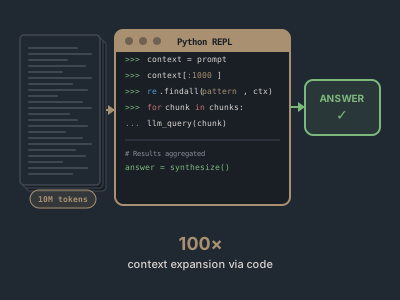
Recursive Language Models: Processing Unlimited Context Through Code
LLMs have fixed context windows, but real-world documents can be millions of tokens. Recursive Language Models (RLMs) let models treat their prompts as programmable objects, recursively calling themselves over snippets to handle inputs 100x beyond their context limits while outperforming long-context baselines.
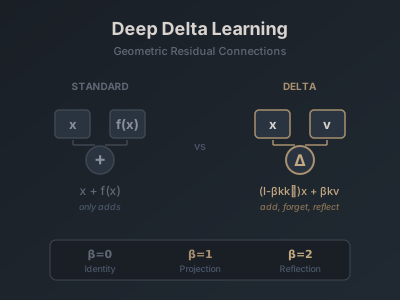
Deep Delta Learning: Rethinking Residual Connections with Geometric Transformations
DDL replaces the standard additive skip connection with a learnable Delta Operator (a rank-1 Householder transformation) that dynamically interpolates between identity, projection, and reflection. This enables networks to model complex, non-monotonic dynamics while preserving training stability.
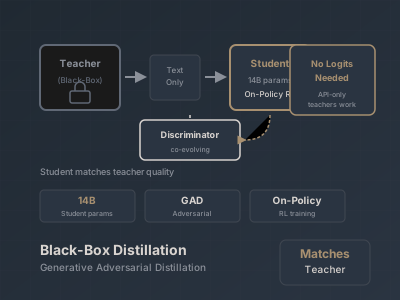
Black-Box On-Policy Distillation: Learning from Closed-Source LLMs
Generative Adversarial Distillation (GAD) enables training smaller models from proprietary LLMs like GPT-5 using only text outputs. By framing distillation as an adversarial game between student and discriminator, GAD achieves what was previously impossible: a 14B parameter model matching its closed-source teacher.
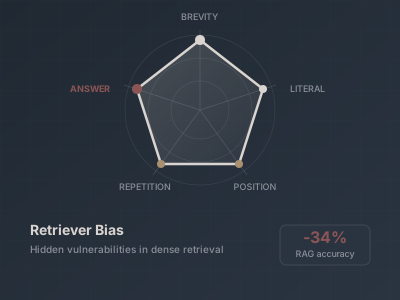
Collapse of Dense Retrievers: Short, Early, and Literal Biases Outranking Factual Evidence
A comprehensive study revealing critical vulnerabilities in dense retrieval models used in RAG systems, showing how biases for shorter documents, early positions, and literal matches cause models to ignore factual evidence.
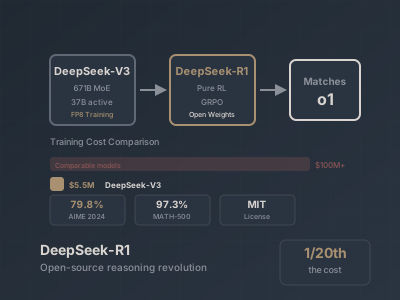
DeepSeek-R1 & V3: The Open-Source Reasoning Revolution
DeepSeek shook the AI industry by matching OpenAI o1's reasoning capabilities at a fraction of the cost—then open-sourcing everything. DeepSeek-V3's efficient MoE architecture and R1's pure reinforcement learning approach demonstrate that frontier AI doesn't require frontier budgets.
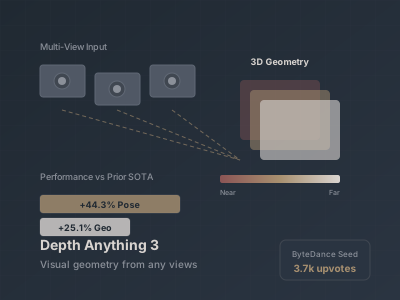
Depth Anything 3: Recovering the Visual Space from Any Views
A simplified approach to visual geometry that predicts spatially consistent depth from any number of images. Using just a plain transformer and single prediction target, DA3 outperforms prior methods by 44% on camera pose accuracy while matching Depth Anything 2's quality.